What Did Jesus Die On? The Word the Church Translated and What It Actually Means
There is a word in the Greek New Testament that has been translated the same way for so long that most people assume the translation is the word itself. The word is stauros. It is worth asking what it actually means.
August 15, 2026
There is a word in the Greek New Testament that has been translated the same way for so long that most people assume the translation is the word itself.
The word is stauros.
It is translated as cross in almost every English Bible you can pick up. And because the cross has become the central symbol of Christianity — on buildings, on jewellery, on flags, in logos — most people have never thought to ask whether that translation is accurate. Whether the word behind the English actually means what the English says it means.
It is worth asking.
What stauros meant in classical Greek
Before the New Testament was written, stauros had a clear and well-documented meaning in Greek literature.
The Liddell-Scott-Jones Greek-English Lexicon — published by Oxford University Press and the standard scholarly reference for ancient Greek — gives the first definition of stauros as "upright pale or stake." It cites Homer's Odyssey and Herodotus as examples. The cross shape — two pieces of wood joined at an angle — comes later in the lexicon's entry, as a secondary meaning that developed under Roman influence.
Vine's Expository Dictionary of New Testament Words, a standard evangelical reference work, says stauros "primarily denotes an upright pale or stake." The New Bible Dictionary agrees.
This is not a fringe position. It is what the major reference works say. Stauros started as a single upright piece of wood.
How the meaning evolved
The honest position — and this site tries to be honest — is that stauros did not exclusively mean a single stake by the first century.
Scholars have long known that both the Greek word stauros and the Latin word crux did not uniquely mean a cross shape, but could also refer to one. The ambiguity was noted by the scholar Justus Lipsius as far back as 1594. Roman crucifixion used various structures. The exact shape of what Jesus died on is not described in the Gospel accounts.
The Gospels do not say: he was nailed to a T-shaped structure. They say he carried his stauros to Golgotha.
What the stauros looked like is genuinely uncertain. The shape has been debated for centuries. What is not uncertain is what the word first meant and what the apostles chose to emphasise when they described the event.
The word the apostles actually preferred
This is where the argument gets more solid.
When Peter preached to the Jewish council in Acts 5:30 he did not use stauros. He said God raised up Jesus "whom you killed by hanging him on a tree." The Greek word is xylon — meaning wood, timber, tree.
Peter used the same word in Acts 10:39. Paul used it in Acts 13:29 and Galatians 3:13. Peter used it again in 1 Peter 2:24.
Five times the apostles chose xylon over stauros when describing the execution. That is not accidental. They were making a deliberate theological choice — connecting what happened to Jesus with Deuteronomy 21:22-23, which says anyone hung on a tree is under a curse. Paul quotes that passage directly in Galatians 3:13 and says Jesus became a curse for us.
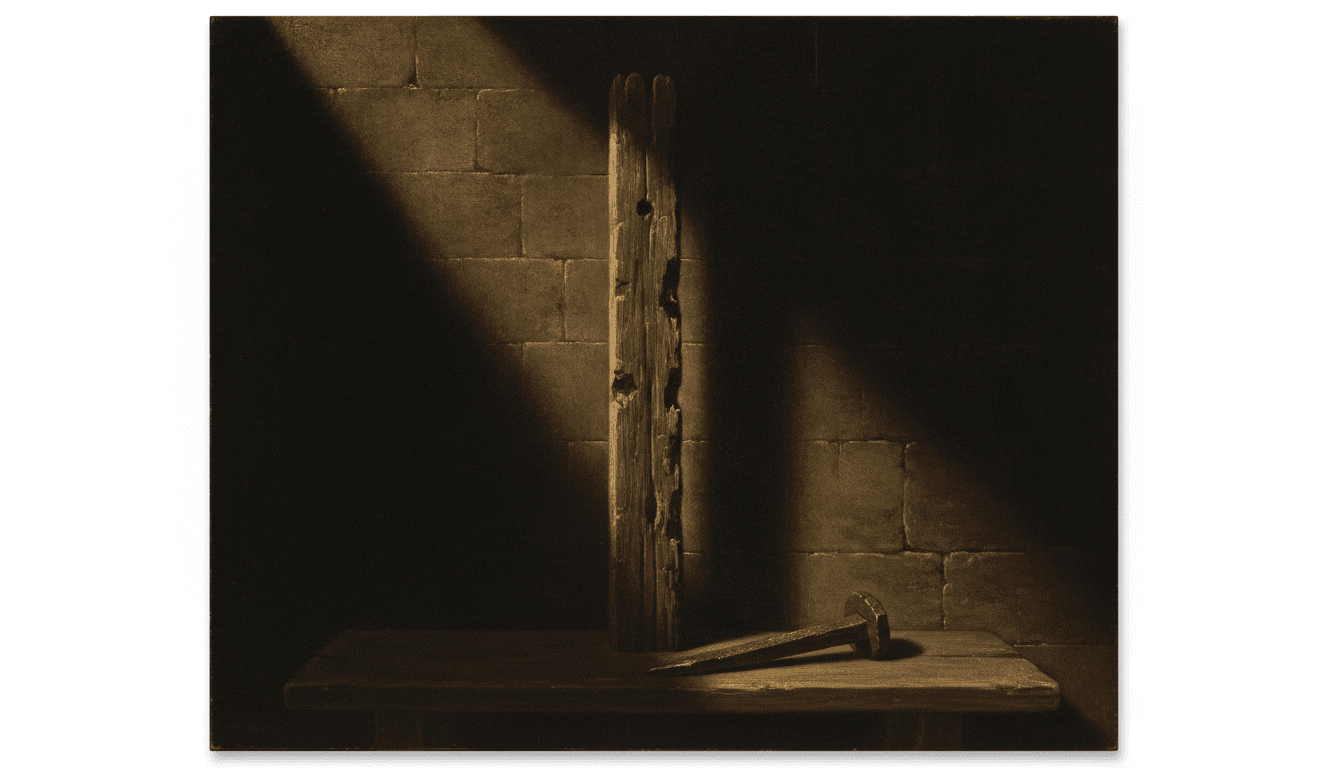
The apostolic language is wood. Tree. Timber. Not a geometric shape. A material.
Every mainstream English translation — NIV, ESV, KJV, NRSV — already translates xylon as tree in those five passages. We are not departing from the published translations on xylon. We are simply being consistent where they are inconsistent.
Why the shape matters less than the wood
The Hebrew scriptures the apostles were steeped in did not frame the execution in terms of a shape. They framed it in terms of wood. A tree. Something lifted up.
Moses lifted up a bronze snake on a wooden pole in the desert so that anyone bitten could look at it and live (Numbers 21:4-9). Jesus himself connected his execution to that image in John 3:14 — as Moses lifted up the serpent in the wilderness, so must the Son of Man be lifted up.
Psalm 22:6 describes the suffering figure as a tola'ath — a crimson worm that fixes itself to the wood of a tree, cannot come back down alive, and leaves its children living because it stayed. The same Hebrew word is used elsewhere in scripture for the scarlet dye that coloured the tabernacle curtains and the High Priest's garments.
The apostles were not thinking about the geometry of the instrument. They were thinking about what wood meant in the Hebrew scriptures.
They were reaching back through centuries of imagery — the tree, the pole, the wood lifted up — to make sense of what had happened.
Why this site uses wooden pole and stake
This site uses wooden pole as its primary term in articles, commentary, and general content. We also use stake when discussing the etymology of stauros directly, and tree or wooden pole when referencing the xylon passages.
We do not use the word cross as an unqualified term. Not because we are trying to be provocative. Because we think the primary meaning of stauros — upright stake or pole — and the apostolic preference for xylon are being obscured by a translation that has become so familiar it no longer invites any questions.
When you see a cross you see a symbol. When you hear wooden pole or tree you are returned to the raw material reality of what happened. A man was nailed to wood. He was lifted up on wood. He stayed on the wood until it was finished. That is what the word says. That is what the apostles described.
The goal of this site has always been to recover what is actually there before the institutional weight of centuries smooths it into something easier to manage. This is part of that same recovery.
How we handle biblical text on this site
When biblical text is displayed on scripture pages — translation comparisons, the interlinear view, quoted passages — this site takes a different approach from the plain language we use in articles.
We do not replace the published translation text in the database. The licensed translations say what they say. BSB says cross. Goodspeed says cross. T4T says cross. KJV says cross. We store those translations as published and display them unchanged when the 'show licensed wording' toggle is active. In the default view we add a display-layer annotation showing the Greek term in brackets — stauros (stake) or xylon (tree / wood) — alongside the English. This is not a change to the translation. It is a scholarly gloss, the same practice used in study Bibles and interlinear Bibles. The licensed text is always one click away unchanged.
On scripture pages we display the original Greek term followed by an interpretive note in brackets:
stauros (stake) xylon (tree / wood)
This is standard scholarly practice. Study Bibles do it. Interlinear Bibles do it. Academic commentaries do it. We are making the Greek visible to a general reader who may never have had reason to look behind the English.
For the xylon passages — Acts 5:30, Acts 10:39, Acts 13:29, Galatians 3:13, 1 Peter 2:24 — the annotation reads xylon (tree / wood). In those passages the mainstream translations already say tree. Our annotation simply names the Greek behind that translation and notes the connection to the wooden pole language we use throughout the site.
The footnote on every scripture page that contains these words explains the method clearly. Nothing is hidden. Nothing is replaced in storage — the annotation is display-only.
The question worth sitting with
The shape of the instrument has been debated for centuries and will likely continue to be.
The more important question is what the apostles were reaching for when they described it as wood. As a tree. As the thing Moses lifted up in the desert so the dying could look at it and live.
They were not describing furniture. They were describing the place where the Pioneer stayed when he could have left. Where he held the shape of the Father's character under the maximum possible pressure. Where costly love reached its furthest point.
Whatever the geometry — it was wood. And he did not come down from it.
That is what the word says. We think it is worth saying plainly.
Written by
Oliver T. Shepherd
Functional Faith — one question at a time.